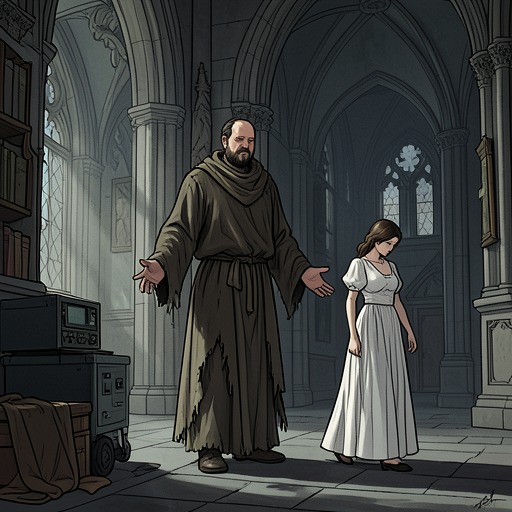
Quasimodo’s failed attempt to reunite Esmeralda with Phoebus
The Hunchback of Notre DameQuasimodo’s failed attempt to reunite Esmeralda with Phoebus is a turning point in the quiet bond between the bellringer and the young woman: he acts to answer her desperate appeal, but Phoebus rejects her, and Quasimodo chooses to bear the disappointment without adding to her distress. The encounter shows both the limits of his ability to help and the self-denial that shapes his devotion.
The Appeal from the Roof
Quasimodo is behind Esmeralda on the roof of Notre-Dame Cathedral, having placed himself where she would be less troubled by the sight of him. From there she looks down over the square and suddenly recognizes Phoebus, the captain. Her response is immediate: she kneels at the roof’s edge, reaches toward him, and calls for him to come and speak with her. Her expression and outstretched arms make plain how much she hopes for even a brief acknowledgment.
Phoebus is crossing the far end of the square on horseback, dressed in arms and decorations. He salutes a beautiful woman smiling at him from a balcony. The distance means that Esmeralda’s appeal does not reach him. Quasimodo, however, sees whom she is addressing and the urgency of her gesture. Her hope is directed toward a man who is, at that moment, attending to someone else.
The episode follows earlier signs of Quasimodo’s difficulty in expressing himself to Esmeralda. On another occasion he approached her as if he meant to speak, but faltered and withdrew. He had also expressed a wish to be made of stone like one of the sculpted figures with which he felt a special kinship. Against that background, his decision to act now is significant: although he cannot offer the response she wants, he tries to bring the person she wants to see within reach.
Quasimodo Seeks the Captain
After Phoebus leaves the balcony area and passes through the street in his night cloak, Quasimodo waits until he has turned the corner, then follows him with his characteristically quick, limping agility. He calls after the captain and, when Phoebus stops, explains that a woman is waiting for him and loves him. Quasimodo identifies her as the gypsy Phoebus knows. His message is not a demand for himself; he is trying to carry Esmeralda’s appeal to its intended recipient.
Phoebus does not agree to return. He objects when Quasimodo holds his horse’s bridle and says that he is about to marry. He treats the woman’s affection as no obligation on his part and insults the messenger’s appearance. Quasimodo nevertheless persists, trying to draw the horse back toward the place where Esmeralda waits. The mismatch is stark: Quasimodo approaches the task with urgency and care, while Phoebus dismisses both the appeal and the person delivering it.
Phoebus kicks Quasimodo in the chest. Quasimodo’s eye flashes, and for a moment he moves as if he might attack the captain. He then straightens and restrains himself. Instead of retaliating, he remarks on how fortunate Phoebus is to have someone who loves him. The brief exchange places Quasimodo’s own attachment to Esmeralda beside the love she directs toward Phoebus: he is the one who acts for her, yet she is waiting for another man.
The Return and Its Aftermath
Phoebus rides away, swearing, and Quasimodo watches him disappear into the darkened street. Quasimodo’s quiet response is to wonder at the refusal: Phoebus has been offered the devotion Quasimodo himself cannot receive, and has turned it away. He returns to Notre-Dame Cathedral, lights his lamp, and climbs back to the tower. He expects to find Esmeralda where he left her, and she is still there.
Esmeralda moves toward him as soon as she sees him and asks whether he has come alone. Quasimodo tells her coldly that he could not find Phoebus. The account makes clear that this reserve is not indifference: he would rather have her blame him than know that he has hurt her, and he has kept the pain of the encounter to himself. When she tells him to go, he leaves rather than challenge her disappointment or insist on his own efforts.
Afterward, Quasimodo stops visiting her cell. Esmeralda occasionally catches sight of his face high on the towers, turned sadly toward her, but he disappears as soon as she notices him. She is not deeply troubled by his voluntary absence and is grateful for it; Quasimodo understands that she feels this way. The failed errand therefore ends not with a reconciliation but with distance. His service has brought him no closer to Esmeralda, and he withdraws because he prefers her displeasure at his absence to causing her further pain.
Significance of the Failed Errand
The episode reverses the expected pattern of a rescue or reunion. Quasimodo can cross the distance between the tower and the street, pursue Phoebus, and deliver Esmeralda’s message, but he cannot compel the captain to answer it. His physical effort meets not a rival contest but a refusal, and the moment when he nearly retaliates is followed by self-restraint. The action he chooses instead is to return and conceal the hurt.
The contrast among the three figures gives the scene its emotional force. Esmeralda’s attention remains fixed on Phoebus; Phoebus refuses to respond to her affection; Quasimodo acts for her while knowing that her desire is not directed toward him. His line about Phoebus’s good fortune makes that imbalance explicit without changing it. The eventual separation from Esmeralda’s cell extends the same pattern: Quasimodo’s devotion takes the form of service followed by withdrawal, while Esmeralda’s relief at his absence confirms that his feelings are not reciprocated. The event thus deepens the portrayal of Quasimodo’s love as self-effacing rather than possessive, even as it leaves him alone with the pain he has chosen not to place upon her.